Zinfai started as a portfolio tracker and grew into the three things an investor actually needs: an honest record of what you own, a plan for what you want, and a credible answer to when you can stop working.
One ledger for everything you own and owe — in the currency you own it in, kept current without you typing prices.
Equities and foreign-listed stocks, ESOPs and RSUs, mutual funds, ETFs, gold and silver, sovereign gold bonds, crypto, fixed and recurring deposits, PPF, EPF, NPS, gratuity and pension, NSC, KVP, SCSS, SSY, MIS, corporate and RBI bonds, land, house property, REITs and InvITs, insurance, physical cash and collectibles — plus the jurisdiction-specific instruments each country actually uses: 401(k), IRA, Roth IRA, HSA, 529, ISAs, SIPPs, gilts, Premium Bonds, superannuation, sukuk and more.
An ISO 4217 currency on every asset and transaction, native amounts preserved, live FX for current value and frozen cost FX for basis — so profit and loss shows the currency move instead of hiding it.
Upload a file and Zinfai parses it — bank and credit-card statements, broker holdings and tradebooks, password-protected NSDL/CDSL CAS files, and EPF, PPF, NPS and SSY statements. Anything without a built-in parser falls through to AI.
See every supported institution →Prices fetched per exchange in the instrument's own currency — NSE/BSE, US markets, LSE, ASX, AMFI NAVs, crypto and MCX — every 30 minutes, with daily FX revaluation.
Pick cards from every part of the app — net worth, daily P&L, allocation, performance, income, expenses, budgets, maturities, equity vs index, attribute and asset insight — then drag and resize them into place. Add the same card twice with different settings; every card remembers its own. One click resets to the default.
Record splits, bonuses, rights issues, demergers, IPO allotments and symbol, name or ISIN changes as transactions, so capital gains and XIRR follow automatically. Gift or move shares between demat accounts, singly or in bulk, carrying the original cost and purchase dates with them.
First-class home, car, personal and gold loans, overdrafts and BNPL, with automatic principal-interest splits, amortization schedules and payoff progress. Net worth = assets + cash − liabilities.
A snapshot of your whole portfolio at a day-close time you choose, in your own time zone. Each day's P&L is what your holdings gained since the snapshot before — money you added or took out is not counted as a gain. Missed days are filled in at each day's own prices.
When a PF, PPF, gratuity, deposit, bond or any of 24 schemes matures or is closed, pay it into the right bank account, net of TDS, in one step. Record PF partial withdrawals without closing the account. The later bank statement line is recognised, so the money isn't counted twice.
Extract expenses from bank and credit-card statements, categorised by AI. Each row is routed as expense, income, investment or uncategorised, so credits and SIPs aren't counted as spending. Group and amortize one-off costs across a window.
20 income categories from salary to cashback, one-time or recurring, plus SIP, lumpsum, recurring and periodic investments — auto-synced from statements and linked back to the source transaction.
Set up systematic investment, transfer and withdrawal plans, and retroactively generate historical SIP transactions at the right NAV so your XIRR is accurate from day one.
You choose the file and upload it — Zinfai never connects to your bank and never asks for banking credentials. It then does the tedious part: pulling out every transaction, holding and balance. Institutions below have a purpose-built parser. Anything else falls through to the AI parser.
| Institution | Savings / current | Credit card |
|---|---|---|
| ICICI Bank | Built-in parser | Built-in parser |
| HDFC Bank | Built-in parser | Built-in parser |
| State Bank of India | Built-in parser | Built-in parser (SBI Card) |
| IDFC First Bank | Built-in parser | Built-in parser |
| Axis Bank | Built-in parser | AI parser |
| Kotak Mahindra Bank | Built-in parser | AI parser |
| Bank of Baroda | Built-in parser | AI parser |
| Standard Chartered | AI parser | Built-in parser |
| American Express | — | Built-in parser |
| Scapia | — | Built-in parser |
| Any other bank, any country | AI parser | AI parser |
Zinfai identifies the institution from the contents of the file, so you don't have to tell it which bank a statement came from.
| Source | What it reads |
|---|---|
| Zerodha | Holdings and tradebooks, CSV or Excel, across multiple sheets |
| Groww | Stock and mutual-fund holdings, plus stock and MF order history |
| ICICI Direct | Equity and mutual-fund holdings, plus tradebooks in both CSV and XLS exports |
| Vested | US holdings and trades — imported into a USD portfolio and kept in USD, with no conversion guesswork |
| INDmoney | US holdings and trades — imported into a USD portfolio and kept in USD, with no conversion guesswork |
| NSDL CAS | Password-protected consolidated statement — equities, mutual funds and sovereign gold bonds |
| CDSL CAS | Consolidated statement — equities and mutual funds |
| MF Central CAS | All mutual-fund folios across registrars, consolidated into one demat account |
| Scheme | Source document |
|---|---|
| EPF / Provident Fund | EPFO passbook PDF, with the employer and employee split kept apart |
| PPF | Account statement PDF from any of the issuing banks |
| NPS | Transaction statement from the Central Recordkeeping Agency |
| Sukanya Samriddhi (SSY) | Account statement PDF from a post office or bank |
| Document | What it reads |
|---|---|
| Intimation u/s 143(1) | The department's own assessment: income by head, deductions, tax, interest, taxes paid, and the demand or refund. Works across every assessment year's layout. |
| ITR-V / acknowledgement | The return as filed: income, tax payable and taxes paid |
The built-in parsers are exact and free — they know precisely where each column sits. The AI parser is the safety net for everything else, and it is deliberately not India-specific: it works out the statement's own currency, date format and decimal separator from the document rather than assuming a country.
This is the one feature that leaves your machine. The AI parser only runs if you have supplied your own API key, and it sends the statement's text to the provider you chose. Leave the keys blank and Zinfai still reads every institution listed above — you simply lose the fallback. Full detail in the privacy statement.
Zinfai already knows your salary credits, interest, dividends, rent and every sale. The Income Tax module puts them under the heads the Act uses, works out the tax under both regimes, and checks the result against the department's own documents.
Nothing is projected to the end of the year. The advance-tax schedule uses the income received so far, and says so when that makes an early instalment look low.
A figure from the filed return, your Form 16 or your bank credits says which one it came from. Where the app can't tell something from your data, it asks you rather than guessing.
The Income Tax module is a record-keeping and estimation tool for Indian resident individuals, not tax advice. File your return from your own documents, and consult a chartered accountant where your situation calls for one.
Not just tracking — a plan to reach your goals. Zinfai's robo-advisor turns your complete financial picture into a personalized, goal-based plan: what to invest, where, and how much each month to actually get there.
Tell Zinfai about yourself once — age, income, expenses, risk appetite, tax slab, insurance, liabilities, and the goals that matter (a child's education, a home, early retirement). The planner assembles a full financial snapshot and asks the AI provider of your choice to generate a plan tailored to you. Review and edit the exact prompt before anything is sent, or paste back a response you ran elsewhere. Every plan is versioned with the exact input snapshot, so you can compare and accept one later.
For every goal, Zinfai computes the monthly SIP needed, projects the corpus you'll reach, flags any shortfall or surplus, and recommends a specific fund — so each goal lands on time.
Your current equity / debt / gold / cash mix against an allocation matched to your age and loss tolerance, with concrete rebalancing actions and the reasoning behind each move.
An instant 0–100 score, graded A–D, across savings rate, emergency fund, allocation, insurance, debt burden, goal progress and tax efficiency — so you know what to fix first.
Recommendations factor in your tax slab and deduction headroom, cite why they suit you, and stick to regulated products. No commissions, no placement, nothing being sold to you.
The planner produces AI-generated guidance for your own research and education — it is not regulated investment advice, and Zinfai is not a registered investment adviser. Verify every recommendation and consider consulting a registered adviser in your own jurisdiction before investing.
Go beyond net-worth tracking and answer the real questions: when can I stop working, how much is enough, and will the money last?
Zinfai computes your Lean, Regular, Fat and Coast FIRE targets from your age, expenses, savings, monthly investment, expected returns and inflation — then projects net worth, contributions, withdrawals and portfolio balance for every year until, and through, retirement.
Dedicated analysis surfaces that go past "what is it worth" to "how good is it, what's maturing, and what is the market doing".
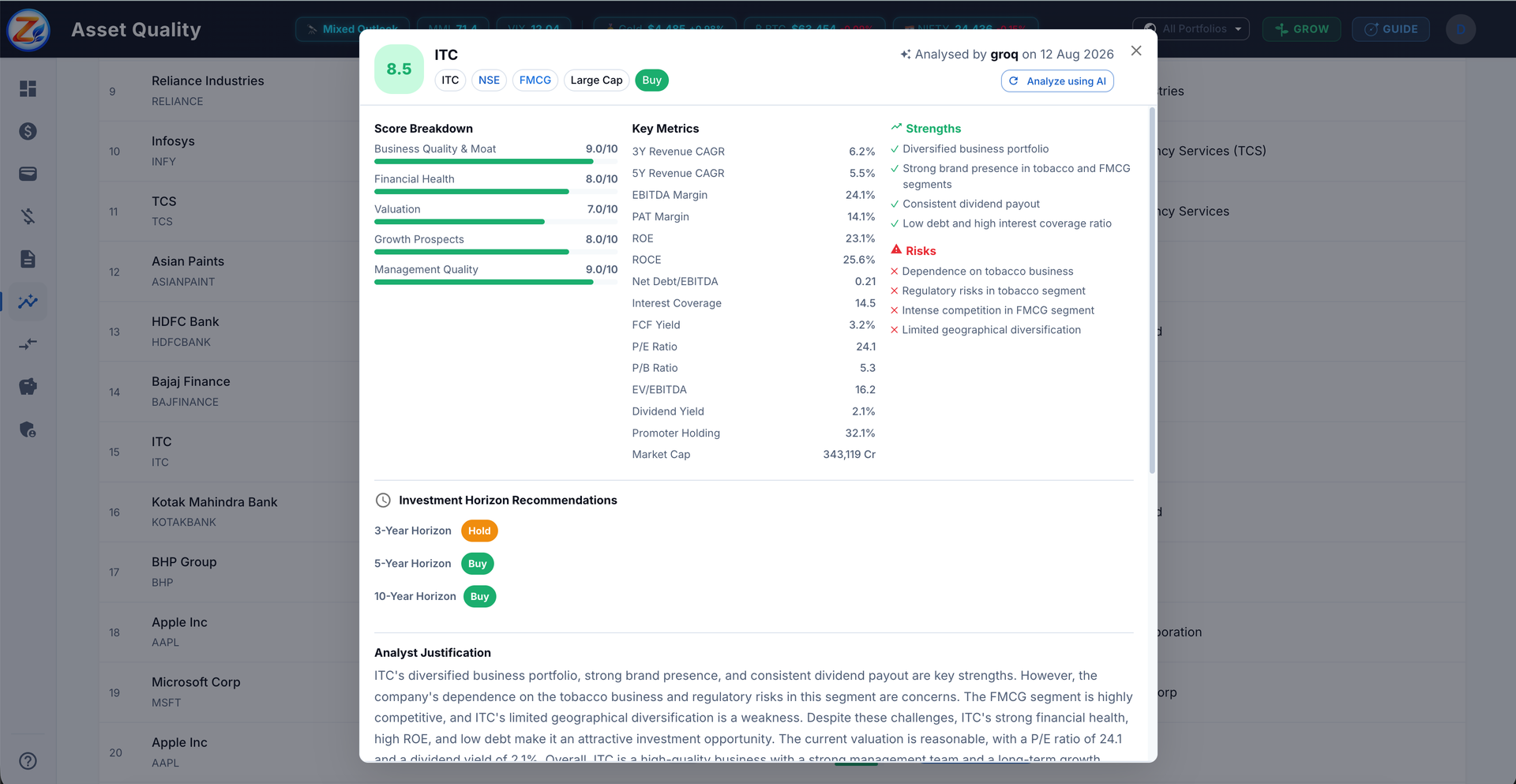
Zinfai puts your AI provider to work as a research analyst, scoring every stock and mutual fund you own from 1.0 to 10.0 with the reasoning to back it up. Scores are cached, refreshed daily by a scheduler, and can be re-run on demand.
An intrinsic value for every stock you hold, blending four models (discounted cash flow, earnings power, Graham, and shareholder payouts) into one figure with a margin of safety and a verdict. It runs on the company's reported per-share figures, each dated to its fiscal period, and a methodology page shows exactly how it's calculated.
A macro regime detector scoring 0–100 across bond yields, dollar strength, volatility, money supply, the Fed balance sheet and gold/equity trends — with buy/sell/hold signals, RSI and SMA indicators, and correlation heatmaps.
Live quotes for your region's indices, commodities, forex, government scheme and FD rates, a financial calendar, macro data (CPI, GDP, FII flows, SIP inflows) and a macro news feed.
Your own rules over portfolio, market and macro signals — "any holding down 5% since last check", "commodity allocation over 15%", "FD maturing within 7 days" — with severity, cooldowns and an inbox.
A visual timeline for FDs, RDs, bonds, NSC, KVP, SCSS, MIS, SSY, PPF, insurance and SGBs, colour-coded by status with projected maturity values.
Category-level performance with trend lines over 7D to 1Y and drill-down to individual holdings, plus allocation by any custom attribute you define — sector, region, strategy, anything.
Track Berkshire Hathaway's cash deployment and 13F holdings from SEC EDGAR filings, and see the top underlying stocks held across all your mutual funds.
Twice-daily AI market analysis filtered to what's actually relevant to your holdings, tagged INFO, WARNING or CRITICAL.
Full export and import with ID remapping — assets, transactions, expenses, income, investments, liabilities, ratings, alerts, planner data and settings — plus optional nightly backup to your own Google Drive.
Mr Mirror is a chat assistant available on every screen. Ask it "how much did I earn in dividends this year?", "which of my funds overlap?" or "what's maturing next quarter?", and it answers from your own records rather than from general knowledge.
It has 32 ways to look things up across the whole app: holdings, returns, spending, budgets, SIPs, alerts, ratings, rates, the market calendar, your FIRE details and your financial plan. Figures about you come only from those records, and it says when an explanation is general knowledge instead.
It answers briefly: tables for figures, bullet points for comparisons, a chart when the shape of the numbers matters. Links take you straight to the relevant screen.
For questions about the market rather than your portfolio, it can run a web search through a provider that supports search. It never presents an answer from memory as a live lookup.
Asking a question never changes your data. Retirement and planning questions are handed to the FIRE and Planner modules that own those numbers, so the chat never contradicts your own screens.
Every AI feature in Zinfai runs through a key you supply, for the provider you choose: OpenAI, Anthropic Claude, Google Gemini, xAI Grok, Mistral AI, DeepSeek, Groq, Perplexity, OpenRouter or AWS Bedrock — and anything else that speaks the OpenAI API works too, via a custom endpoint. Plans, ratings, statement parsing, Mr Mirror's answers and news analysis are generated with your key and stored in your local database. There is no Zinfai server in the middle — because there is no Zinfai server.
Leave the keys blank and everything else still works: tracking, statements in supported formats, prices, XIRR, snapshots, net worth, alerts and the entire FIRE engine are all deterministic and need no AI at all.
No key yet? Google Gemini, Groq and OpenRouter all offer free keys. On first login Zinfai shows you how to get one in a couple of clicks and tests it before saving.
Configure keys in Settings or a local .env. The provider you mark as Primary is always tried first, for every feature; the others act only as fallbacks.
Preview and edit the exact prompt before it's sent — or run it elsewhere and paste the response back in.
No cloud accounts, no data sharing, no subscription. Install Zinfai and see your whole financial life in one place.